
What a Professional Baking Certificate in Atlanta Actually Looks Like, Taught by a Chef Who’s Lived It
What a Professional Baking Certificate in Atlanta Actually Looks Like, Taught by a Chef Who’s Lived It
If you’re researching a professional baking certificate in the Metro Atlanta area, the instructor matters just as much as the curriculum. The foundation of Kennesaw State University’s Community and Professional Education (CPE) Baking and Pastry Certificate is its instructor, Michelle Di Maio Pellegri.
Michelle brings a career that spans a French culinary internship, several respected Atlanta kitchens, and real corporate experience into every class she teaches. Here’s what the certificate covers, who it’s designed for, and Michelle’s own words regarding what every student should know before they enroll.
What the Baking and Pastry Certificate Covers
The certificate combines hands-on baking instruction with ServSafe® Manager Certification so students leave with both technical skill and the food safety credential employers expect.
Class begins with fundamentals. On day one, students will make blueberry muffins and biscuits, recipes simple enough to let Michelle focus on teaching mise en place and proper scaling before moving into more advanced techniques.
“I want to set the expectation that preparedness prior to walking into the kitchen is nonnegotiable but also leave room for the fact that everyone will also bring their unique cooking and life experiences,” Michelle said. “Errors and mistakes are perfectly fine as long as they are paired with the willingness to investigate what went wrong and try again. The goal is exposure to technique, not perfection on day one.”
From the fundamentals, the curriculum builds toward classic techniques students will use across bakeries, restaurants, hotels, and catering kitchens. Michelle points to gluten development as one concept that students consistently underestimate at first.
“You have to really understand the goal of the recipe, whether it’s a flaky biscuit, a cake, a bagel, or a croissant. They all use flour, but understanding which flour to use and the numerous factors that affect the outcome takes time and practice. One size does not fit all.”
Why ServSafe Is Built Into the Program
A baking certificate teaches technique. ServSafe Certification teaches the food safety knowledge needed to keep a kitchen running and a business compliant in Georgia. Michelle considers it essential, not an add-on.
“I had no idea how much I loved food science and learning about all the ways foods can make you sick until I took ServSafe as a culinary student,” she said. “Best practices in food safety are not intuitive. Understanding and applying ServSafe not only helps prevent foodborne illness and injury, but allows kitchens to run more efficiently and businesses to ultimately be more profitable.”
A Foundation Built on Classic Technique
The certificate is rooted in classic baking technique and industry best practices, the same foundation Michelle relied on across every kitchen she’s worked in.
“Every bakery and restaurant has a unique culture, but success in this industry is based on a person’s ability to apply and adapt those classic techniques in different situations,” she said.
Who This Program Is For
The certificate is designed for adult learners balancing real schedules and real responsibilities. Three groups tend to find the most value:
Career-changers: adults moving out of a different industry and into baking as a profession, drawn by a structured path instead of trial and error.
Passionate home bakers ready to go pro: people who have outgrown home baking and want the food science, time management, and professional kitchen exposure that home practice doesn’t provide.
Working food service professionals: bakers and cooks already in the industry who want a recognized credential to back up the skills they’ve built on the job.
Michelle put it simply when asked what she’d tell someone unsure if they’re ready: “Everyone struggles with imposter syndrome, and learning new skills can be humbling. Sometimes you just have to fake it until you make it. My goal is to put students at ease so they can work through recipes without fear of failure. We are most definitely going to make mistakes, but we’ll work through it together. Failure is often the best teacher.”
Meet Your Instructor: Michelle Di Maio Pellegri 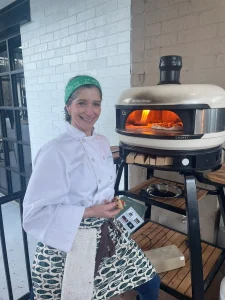
Michelle’s path into culinary education wasn’t a straight line, and that’s exactly what makes her teaching distinctive. She spent time in both professional kitchens and the corporate world before finding her way to teaching, and she says the contrast between the two will shape how she approaches every class.
“Truly polar opposite experiences, and I’m grateful for the exposure to both,” she said. “Understanding the possibilities and potential that the corporate world can offer is so important.”
Her credentials are specific and hard-earned. Michelle completed an internship at École de Cuisine La Varenne in Burgundy, France, a three-month immersion of 12-15 hour days, six days a week.
“It was akin to a baptism by fire,” she said. “I walked away with a true sense of terroir culture. Learning to lean into flavors and traditions that can only be replicated in that place.”
In Atlanta, she worked at Bacchanalia, Star Provisions, and Varasano’s, three kitchens known for very different things but united by one standard.
“What they each have in common is the desire to produce meals at the highest level,” Michelle said, pointing to Varasano’s pursuit of the perfect pizza dough as a lesson in persistence. “Mastery takes practice and the willingness to accept failure along the way. Just don’t quit.”
Ask her what single lesson she’d teach if she could only pick one, and the answer comes without hesitation: croissants.
“The ability to transform basic ingredients, flour, milk, butter, salt, sugar, and yeast, into gorgeous flaky layers always makes me smile. It is so deeply satisfying and magical.”
Frequently Asked Questions
How long does the Baking and Pastry Certificate take?
The program runs for 34 weeks, with 58 sessions held twice a week in the evening. It combines hands-on baking instruction with ServSafe® Manager Certification, taught in a professional kitchen setting at the KSU Center in Kennesaw, GA. Students earn 23.2 CEUs upon completion.
Is the Baking and Pastry certificate worth it for a career change?
According to instructor Michelle Pellegri, a structured certificate exposes students to food science, time management, and professional kitchen efficiencies that self-taught baking at home typically doesn’t offer, along with the accountability of a set curriculum and weekly instruction. For students considering a career as a professional baker or pastry chef, this certificate is an investment in building the skills and confidence needed to succeed in a professional kitchen. Rather than piecing together knowledge on their own, students gain focused, hands-on instruction designed to prepare them for the demands of the industry.
What is ServSafe and do I need the certification?
ServSafe® Manager Certification covers food safety best practices that prevent foodborne illness and help kitchens run efficiently. It’s included as part of the certificate alongside hands-on baking instruction.
Do I need professional kitchen experience before enrolling?
No. Michelle structures day one around fundamentals like mise en place and scaling, and emphasizes that the goal is exposure to technique rather than perfection from the start.
What will I be able to do after completing the certificate?
Students leave with classic baking technique, food safety certification, and skills built for use across bakeries, restaurants, hotels, and catering kitchens; it mirrors the same foundation Michelle has relied on throughout her own career.
Interested in learning from an instructor who has lived this career firsthand?
Explore Kennesaw State University’s Community and Professional Education Baking and Pastry Certificate and start building professional-level skills.


